Sustainable growth report 2024
Sustainable growth report 2025
CARGO VAPOUR EMISSIONS
Cargo vapour emissions remain a part of our operations. Purging and venting are required during activities such as dockings, yard stays and changes in cargo grades, and therefore cannot be fully avoided. These operational factors continue to influence the frequency of vapour release.
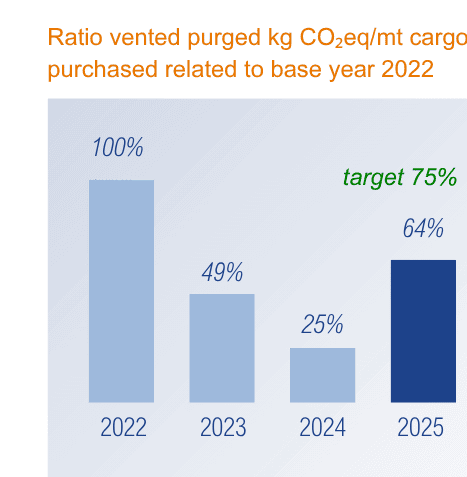
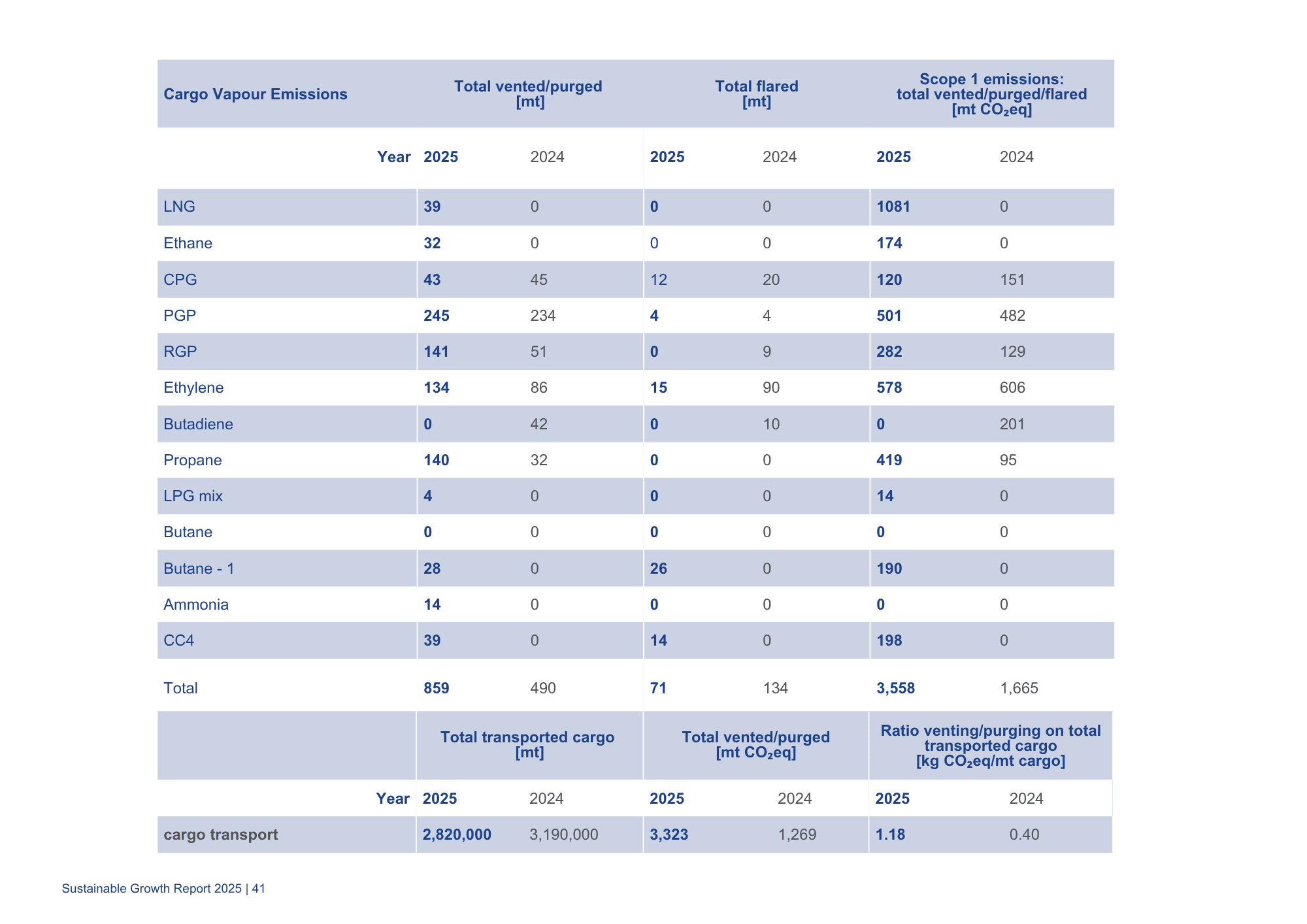
Venting and flaring operations in 2025 resulted in 930mt of total product loss resulting in 3,558 mtCO₂eq of direct-to-air scope 1 emissions. A new category compared to previous years, ethane emissions, has been added. As recent IPCC assessment reports do not provide a direct GWP value for ethane, the indirect GWP-100 of 5.5 from IPCC AR4 has been applied.
Following the strong improvements achieved in previous years, performance in 2025 showed a less favourable outcome. This was largely driven by the vessels in the petrochemical operations under time charter. In these cases, opportunities to optimise tank preparation planning or reduce purging operations were limited, as vessels are required to operate strictly in line with charterers’ instructions.
As a result, several purging and venting activities were unavoidable, which had a direct impact on overall emissions.
We continued to focus on minimising the impact of gasing up and cooling down activities on LNG vessels. We have placed greater focus on cargo stripping, ensuring that all methane remaining in the cargo tanks is used, leaving only the ethane fraction (which cannot be used in our engines) for purging operations.
Another positive development in 2025 was the first application of vapour storage during gassing-up and cooling-down operations on Coral Evolution. During this operation, one cargo tank was cooled down while the resulting boil-off gas was stored in the other tanks for later use as fuel. This significantly reduced the need to send LNG to the flare and demonstrates how operational optimisation can contribute to more efficient and lower-emission LNG handling when schedule conditions allow.
While progress in developing new technical solutions has been slower than anticipated, we continue to explore both technical and operational measures to further reduce emissions in the coming years. Overall, 2025 reflects a year of mixed results. We remain committed to further reducing cargo vapour emissions and continuing this progress.