Sustainable growth report 2024
Sustainable growth report 2025
BEHAVIOUR
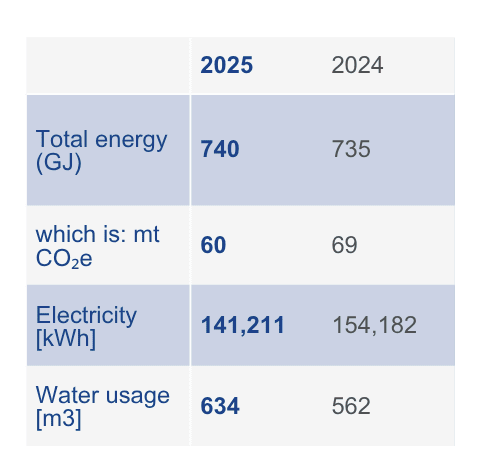
Emissions that are not related to the fuel and the vessel are categorized under ”other emissions”. These include scope 2 emissions, related to our office building, and scope 3 emissions, such as goods and services. For scope 3 emissions not related to fuel, we used established calculation methods and estimation tools available through the dedicated platform Salacia.
Scope 2 emissions
The office building is connected to the district heating network in Rotterdam, which supplies hot water for heating. More than half of the supplied hot water is generated using waste heat, biomass, and energy recovered from waste processing, while all electricity consumed comes from renewable sources.
Scope 3 emissions
The largest share of our Scope 3 emissions consists of the well-to-tank emissions from the fuel we consume. These emissions are calculated using emission factors from AR5 (the IPCC’s Fifth Assessment Report) and EU Directive 2009/16/EC.
For the remaining Scope 3 categories, we have revised our calculation methodology. As in the previous year, we also used the Salacia platform this year to map our emissions. Salacia uses either a spend-based or hybrid methodology.
Spend-Based method:
Applied to categories such as purchased goods and services, upstream transportation, waste generated in operations, business travel, and employee commuting. Due to the large number of suppliers involved, collecting emission data from each supplier would be highly resource-intensive. Instead, we use financial data in combination with Salacia’s platform to estimate these emissions.
Hybrid method:
Combines supplier-specific activity data with secondary data to address data gaps. This approach was applied to capital goods. These updated methodologies enable us to measure and manage our Scope 3 emissions more accurately and effectively.
There is a significant difference between the capital goods purchased in 2024 and 2025. In 2024, the Coral Evolution, a newbuild vessel, entered our fleet. In 2025, no newbuilds were added, resulting in significantly lower CAPEX.